Is Annapurna Base Camp Trek Safe? Comprehensive Safety Guide
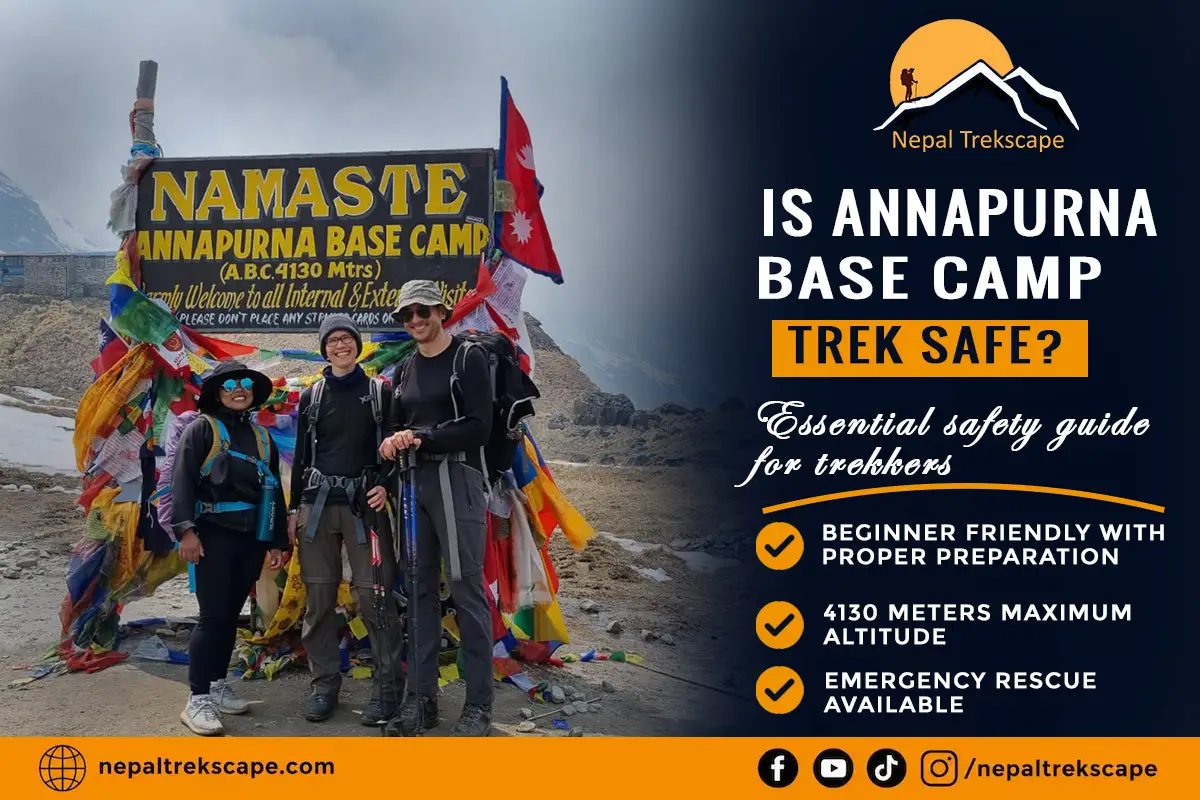
Annapurna Base Camp Trek is one of the famous epic Himalayan adventure and beginner friendly with proper preparation. Every year, many trekkers across the world come to Nepal to feel the moment of standing at the heart of the Annapurna Sanctuary. The most common question asked by the trekkers planning to experience ABC Trek is: Is Annapurna Base Camp Trek Safe?
Yes, trek to Annapurna Base Camp is safe when trekkers follow the safety protocols, choose right season and trek carefully. Enclosed by the Annapurna massif and other snowcapped peaks, considered as one of the safest high-altitude treks in Nepal.
In this comprehensive Annapurna Base Camp Trek Safety Guide, we have covered everything in detail about:
- Advantage of choosing the right trekking seasons
- Understanding inherit risks during high-altitude trek and practical ways to minimize it
- Benefits of choosing the right trekking season
- Know the role of government certified guide towards the safety of trekkers throughout the trek
- Taking informed decision whether to hire experienced trekking guide or not
Moreover, this guide is beneficial and helps to take right decision and prepare accordingly for both beginners and intermediate trekkers.
What are the factors that ensures safety of the Annapurna Base Camp Trek?
The Annapurna Base Camp Trek is regarded as comparatively safe high-altitude Himalayan trek when compared popular Himalayan adventures such as:
Major factors that ensure Trek to Annapurna Base Camp is safe journey:
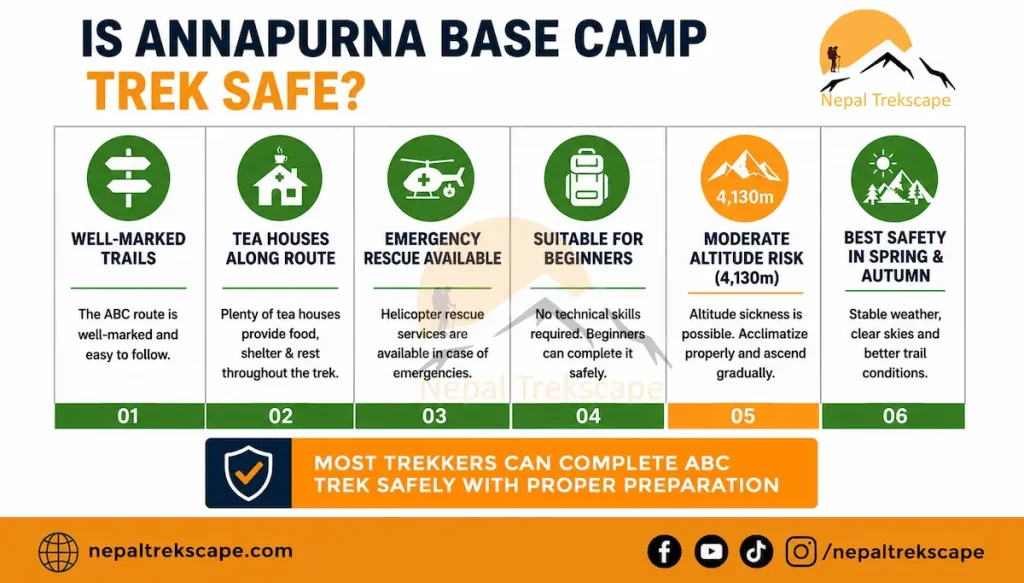
Well-established trekking paths and well-marked trails
The trekking path of ABC Trek is considered as the most traveled trekking route of Nepal. Every year, thousands of domestic and international trekkers explore the well-marked trail of this trek. Since, the trails leading to Annapurna Sanctuary already traveled by many trekkers which significantly minimizes the navigation risks.
Availability of teahouses and basic facilities along the route
Unlike other popular trekking route, the trail of ABC trek passes through traditional villages almost each trekking day. Hence, one of the key advantages for Annapurna Base Camp Trek Safety is availability of tea houses throughout the trail. Moreover, you can access the services and facilities offered by tea houses such as:
- cozy accommodation
- Local cuisines
- Wi-Fi access with extra charge (this facility is limited above 3000 meters of altitude)
- Safe drinking water
- Mobile charging facilities
Availability of emergency rescue
As we know, there is inherit risk of high-altitude sickness with the rise of altitude. Unfortunately, if the trekker’s health condition gets worse due to Acute Mountain Sickness (AMS), there is a facility of helicopter evacuation.
Technical skill is not required
Trek to Annapurna Base Camp does not require any technical skill to complete it successfully. Beginner trekkers with good physical fitness can enjoy the natural amphitheatre of Annapurna with proper preparation.
Understanding Possible Challenges During the Annapurna Base Camp Trek
Although the Trail of ABC is regarded as the safe, there is inherit risks with the rise in altitude and changing weather. Hence, understanding the possible challenges involved during the journey to ABC trek helps trekkers to prepare better.
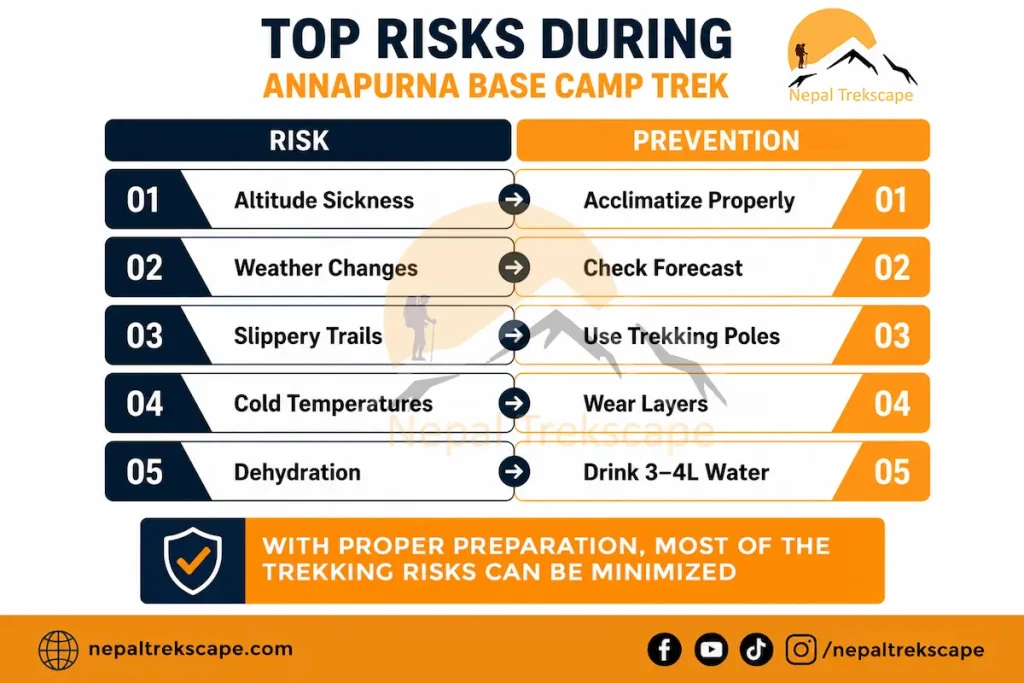
Possible risks during the exploration of Annapurna Base Camp Trail are:
Altitude Sickness at Annapurna Base Camp
Nestled at an altitude of 4140 meters, there is a risk of altitude sickness due to low oxygen level regardless of good physical fitness.
Common symptoms experienced by some of the trekkers includes:
- Mild headache
- Nausea
- Unsteadiness
- Physical exhaustion
- Loss of appetite
- Difficulty in sleeping
Possible ways to minimize the above common symptoms includes:
- Gain elevation gradually to allow your body to adjust environment of rising altitude
- Always stay hydrated
- Avoid the consumption of alcholic beverages
- Match your pace of walking according to the physical condition of your body
- Let your guide know immediately if any symptoms appear
- Never skip acclimatization and give sufficient time to adjust the environment of higher altitude
Unpredictable weather
Annapurna Base Camp Trek weather condition is unpredictable. Even during the feasible trekking season, trekkers may face:
- Sudden snowfall at higher elevation areas
- Variation in temperature
- No clear view of snowcapped mountain due to fog
- Unexpected rainfall
- Strong wind at high-altitude area
Important Note: According to Senior Male Trekking Guide, Ajit Adhikari “Trekkers must carry layered clothing and weather-protective trekking gears to ensure safety”.
Potential trail hazard and slippery section
The ABC Trek demands walking on diverse terrain which includes:
- Thousands of Steep step stones which are irregular in shape
- Suspension bridge that feels unstable underfoot
- Uneven and rocky path
- Frozen moraine section between MBC and ABC in the winter season
- Slippery trail caused due to snowfall and rainfall increasing the risk of injuries such as sprain, slips, ankle twists and minor cuts
Important Note: According to Senior Female Trekking Guide, Bunu Tamang “Trekkers must use trekking poles and appropriate footwear for better stability while navigating the trail”.
Potential Risks of Avalanche and Landslides
There is a high chance of Avalanche and Landslide during off seasons due to monsoon, heavy snowfall and extreme weather events. In such situation, experienced guides adjust the itinerary and can navigate the alternative routes to ensure trekker’s safety.
Essential safety tips for Annapurna Base Camp Trek
Following the Annapurna Base Camp Trek Safety Tips helps to minimize the potential risk significantly. Following are the essential safety tips for ABC Trek:
Always Choose the favourable trekking season
Favourable seasons to trek ABC are Spring (March – May) and Autumn (Late September – November). Due to global warming, there is shift in Annapurna Base Camp Trekking season. According to Ajit Adhikari, “December is also the best season for ABC Trek as sky is clear but temperature is cold”. Whereas monsoon is considered as unfavourable season as trails became slippery due to rainfall and high risk of landslide.
Acclimatize properly with the rise in altitude
With the rise in altitude, you must give time to your body for proper acclimatization. Moreover, you must perform the acclimatization activities in order to minimize the risk of high altitude sickness.
Pack essential safety gears and equipments
You must pack the essential safety gears and equipments such as:
- Trekking poles
- Warm and layer clothing
- Medical First Aid Kit
- Headlamps
- Raincoat
- Waterproof trekking boot
Stay hydrated and eat nutritious food
While walking on steep uphill trail and stone steps, you must drink plenty of water to stay hydrated. Moreover, as a mindful trekker, you must eat nutritious food to stay energetic while trekking.
Is Annapurna Base Camp Trek Safe for Solo Trekkers?
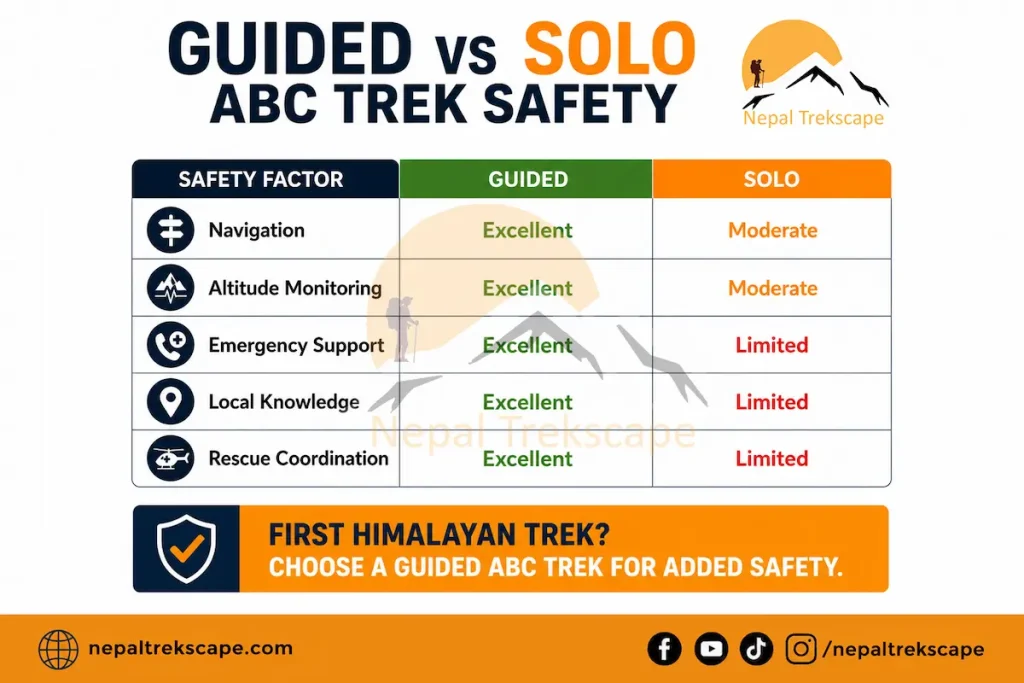
Annapurna Base Camp Trek Safety for Solo Trekkers highly depends upon the experience and level of preparation. If you are a beginner trekker then we recommend you to hire experienced trekking guide to minimize the potential risks.
Potential Challenges for Solo Trekkers during ABC Trek includes:
- Limited emergency support for helicopter evacuation
- Difficulty in navigation
- Cannot explore the local culture and tradition deeply
- Difficulty in altitude monitoring
Below table shows the comparison between guided and solo ABC Trek with safety factors.