Annapurna Base Camp Trek Difficulty: Everything you must know before your journey
Every year, thousands of enthusiastic trekkers plan to trek the Annapurna Amphitheatre. The Annapurna Base Camp Trek Difficulty is the frequent concern among the trekkers who are willing to reach to the altitude of 4130 meters. Can I successfully complete the trek to Annapurna Base Camp is the common questions among many trekkers. Whether you are beginner or intermediate trekker, you must know what challenge you may face and ways to overcome it.
Unlike mountain expedition, Annapurna Base Camp Trek does not demand technical mountaineering skills. However, it requires strong determination, endurance, good physical fitness and right preparation. The major challenge arrives with:
- rise in the altitude
- steep ascent to stone staircase
- unpredictable weather condition
- demanding long walking days
This is the complete guide which you must know to decide whether this Himalayan adventure is suitable for you. Moreover, it covers every aspect of the trekking journey such as altitude challenges, fitness requirements and essential trekking tips.
How tough is Annapurna Base Camp Trek?
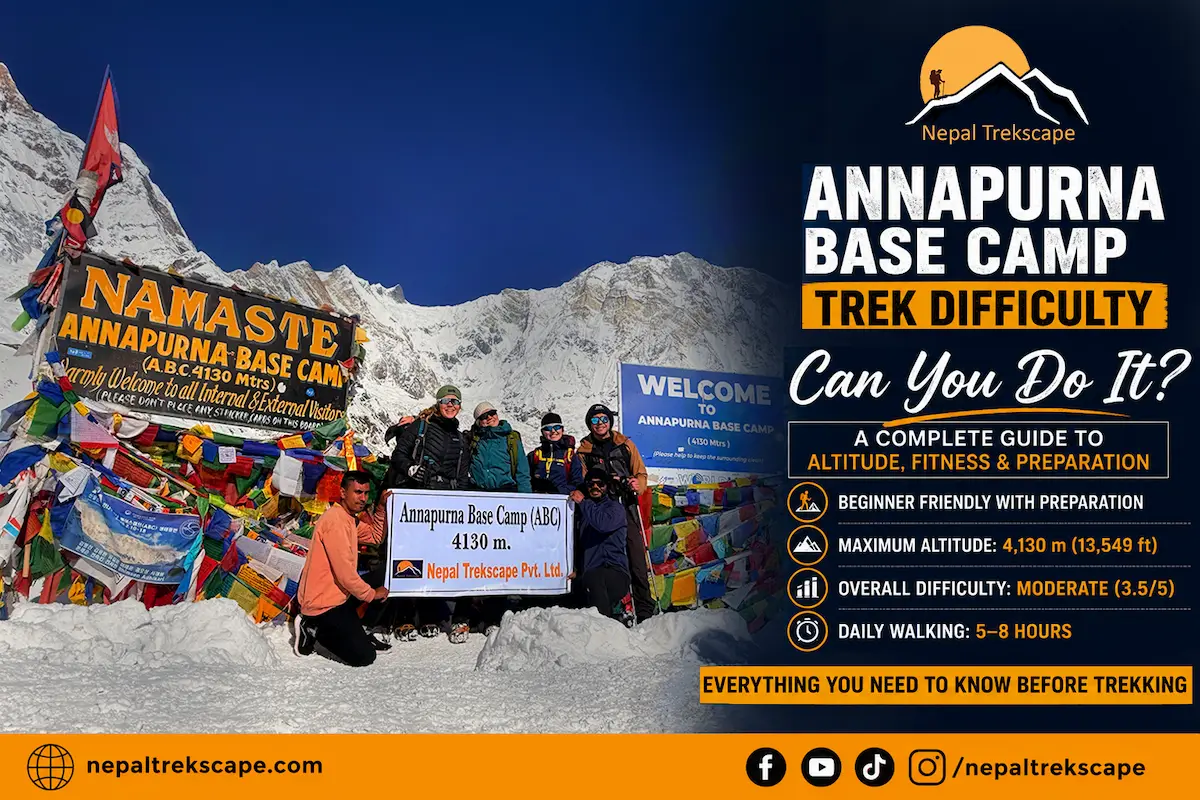
The Annapurna Base Camp Trek Difficulty is categorized as moderate. This indicates that:
- It is ideal beginner trekkers with the right pre-trek preparation
- Previous trekking experience is not compulsory
- Does not require technical climbing experience
However, “moderate” does not imply easy. The trek arrives the base of 10th highest mountain in the world include:
- The trail includes climbing thousands of stone steps
- Trek involves successive days of 6 to 8 hours of strenuous walk
The table below provides you quick overview of the Annapurna Base Camp Trek Difficulty Rating based on factors such as altitude, daily distance, terrain, technical skill, fitness requirement and weather variability.
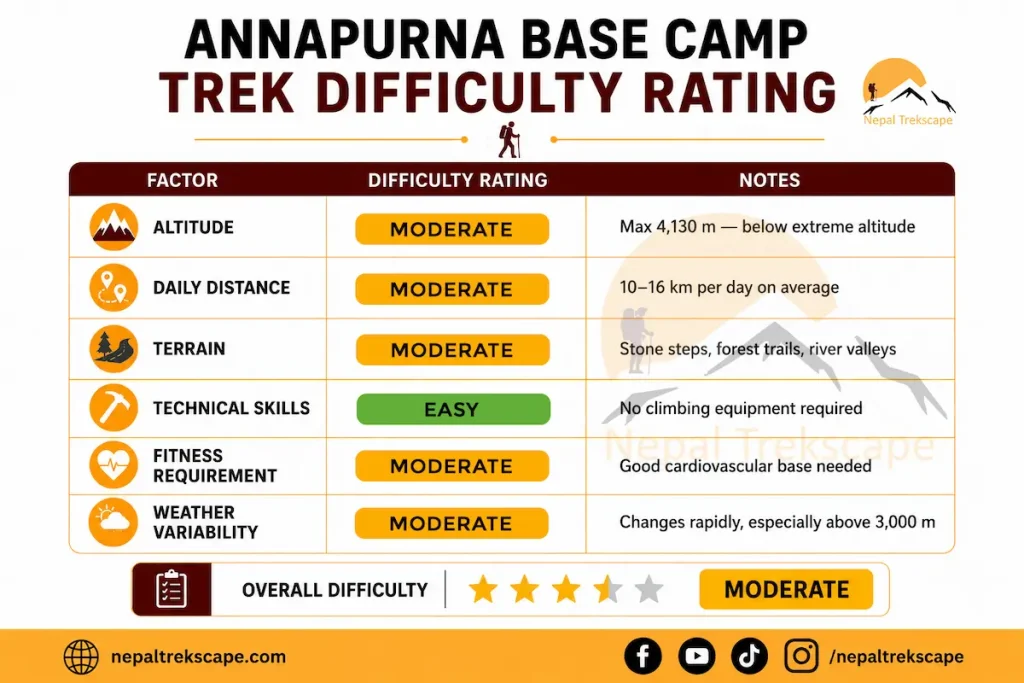
Generally, Annapurna Base Camp Trek Difficulty can be analyzed as moderate. So that it is one of the Nepal’s favourable high-altitude trekking adventures for physically fit beginners with proper preparation.
What factors makes the Annapurna Base Camp Trek Difficult?
Even though the Annapurna Base Camp Trek is regarded as moderate-level trek, various factors make the adventure physically demanding. The difficulty comes through the elevation, uneven terrain, diverse landscape, steep ascents and unpredictable weather condition. Moreover, understanding these factors definitely helps the enthusiastic trekkers to do proper preparation before starting this trekking journey.
The key factors that contribute to make the Annapurna Base Camp Trek Difficult include:
Rise in altitude with reduced oxygen level
As we know, level of oxygen reduced with the rise in the altitude. During the journey, trekkers must reach Annapurna Base Camp which is considered as the highest point of the trek. At the elevation of 4130 meters, trekkers may experience:
- Loss of appetite
- Shortness of breath and tiredness while walking
- Disrupted sleep
- Headache
Although, every high-altitude trek has inherited risk of altitude sickness but this trek has lower risk compared to other popular high-altitude trek. According to senior female trekking guide, Bunu Tamang “Many trekkers may experience minor symptoms of altitude sickness such as mild headache, faster fatigue while walking uphill. These symptoms are manageable as I have structured the itinerary which ensure gradual altitude gain and allows proper acclimatization.”
Long Daily Trekking Hours and steep uphill climb
Trekkers generally walk about 5 to 7 hours continuously which is approximately 8 to 15 kilometers daily. Day 03 to Day 08 involves the uphill sections where some days are challenging and moderate.
Day 03: Trek to Ulleri from Hille
This section include climb over thousands of steep stone staircase. Even though it is considered as low-altitude, but many trekkers experience it as physically demanding.
Day 04: Trek to Ghorepani from Ulleri
This section includes continuous uphill walk following trail inside rhododendron forests demanding continuous effort for several hours.
Day 05: Early morning hike to Poon Hill from Ghorepani and trek to Chuile
The section of early morning hike to Poon Hill from Ghorepani requires short duration of time to complete but includes steep uphill climb. Likewise, trek to Chuile from Ghorepani include blend of ascents to uphill and descents to downhill. Mostly, this section of trek includes downhill walk.
Day 06: Trek from Chuile to Sinuwa
This section demands a gentle to moderate uphill walk featuring gradual ascents and descents passing through forests and villages.
Day 07: Trek to Deurali from Sinuwa
This section is considered as the one the longer uphill days of the entire trek. Moreover, it demands steady uphill climb passing through bamboo forests, small settlements and mountain landscape with gradual altitude gain.
Day 08: Trek to Annapurna Base Camp from Deurali
This section includes gentle uphill climb but the rise of altitude from 3230 m to 4310 m makes it challenging. Likewise, oxygen level is reduced due to high altitude and trekkers feels fatigue more quickly.
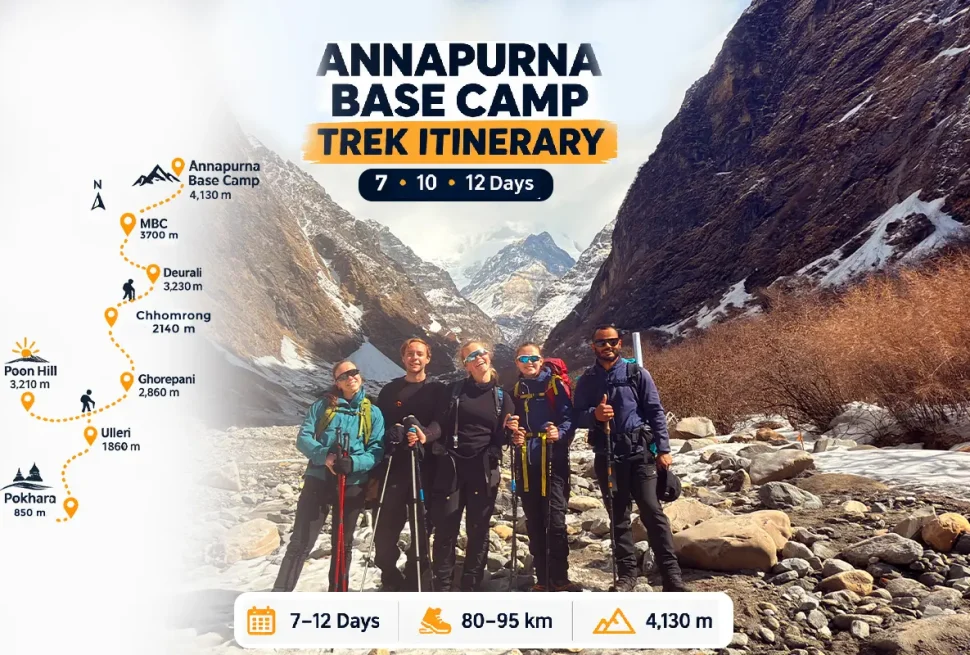
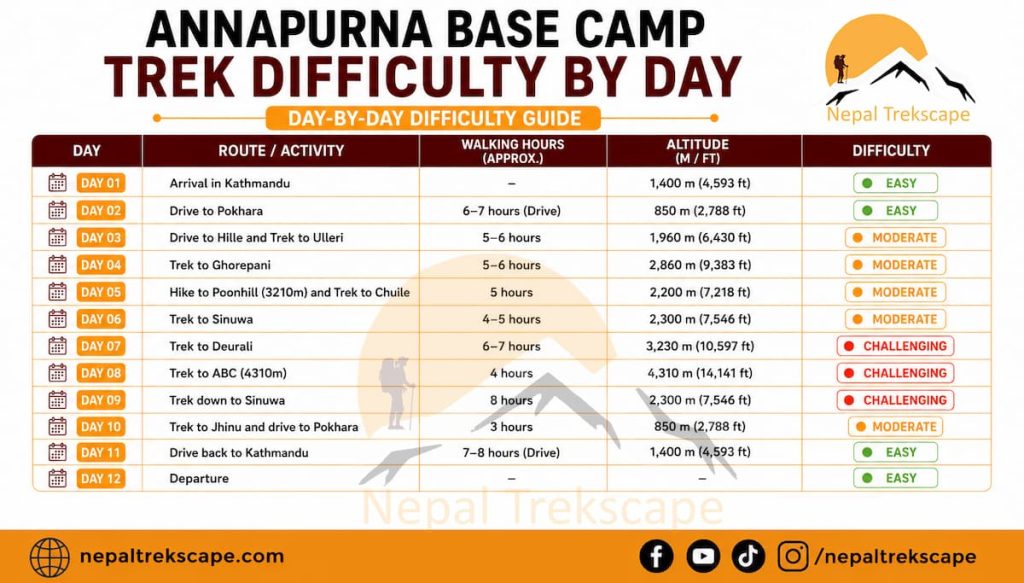
Below is the standard 12-day itinerary of the Annapurna Base Camp trek showing difficulty level from Kathmandu to Annapurna Base Camp. Moreover, it also shows the walking hours and altitude of each day which help the trekkers to plan and prepare accordingly.
Frequently changing weather
As we know, the weather of mountain region is unpredictable. Moreover, trekkers may face heavy rainfall, snowfall, morning frost, warm afternoon and forceful wind in a single trekking day. Hence, unpredictable condition of the weather in the Annapurna Region contributes to make the Annapurna Base Camp Trek difficult.
Annapurna Base Camp Trek Difficulty compared with other popular treks of Nepal
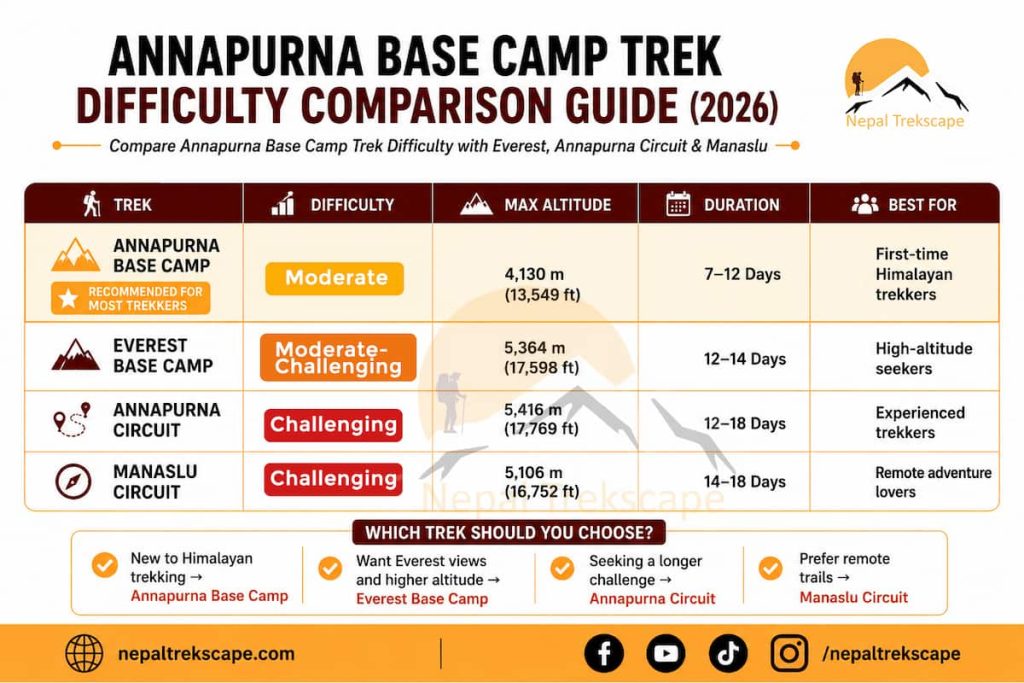
Comparision of Annapurna Base Camp Trek Difficulty with Nepal’s other popular trekking routes helps the trekkers to make best decision to choose right adventure. Although the ABC Trek is regarded as moderate-level trek, altitude gain, daily waking hours and steep ascents through stone staircase makes physically demanding.
The below table provides the quick overview of Annapurna Base Camp Trek Difficulty when compared to Everest Base Camp, Annapurna Circuit and Manaslu Circuit.
Can beginner complete the Annapurna Base Camp Trek?
Absolutely, the beginner can complete the Annapurna Base Camp Trek but with the proper pre-trek preparation.
Some essential tips for the beginner trekkers:
- Follow the standard itinerary which includes gradual ascents and time for proper acclimatization
- Never skip the acclimatization days and its activities
- Always follow the principle of “climb high, sleep low” while performing acclimatization activities
- Listen to your body
- Adhere to the guidance of your lead guide
- Drink plenty of water during trek to stay hydrated
- Walk slowly during steep ascent to minimize the shortness of breath
- Use trekking pole while climbing uphill trail and stone staircases
- Prepare yourself mentally
- Descent to lower altitude if you suffer from High Altitude Sickness
- Complete the pre-trek preparation which fulfill the Annapurna Base Camp Trek fitness requirements
Frequently Asked Questions:
Is Annapurna Base Camp Trek really difficult?
Annapurna Base Camp Trek is regarded as moderate level trek demanding good physical fitness and proper pre-trek preparations.
Is Annapurna Base Camp Trek achievable for beginners?
Yes, ABC Trek is achievable for beginners with proper preparation which includes cardiovascular and strength training.
What is the age limit for ABC Trek?
Basically, there is no age limit for ABC Trek. Even young trekkers of age 10 to older trekkers of age 60 plus can complete this trek who have good physical fitness with the proper guidance.
What makes the ABC trek physically demanding?
Being a high-altitude trek, diverse landscape, steep uphill climb and thin air with the rise in altitude makes the ABC trek physically demanding.
Do I need trekking experience to complete the trek to Annapurna Base Camp?
No, you do not need any trekking experience to complete this trek. However, you must need proper training to develop physical strength which is required during your trekking journey. As a beginner you must have good physical fitness too.
Conclusion:
Annapurna Base Camp Trek Difficulty is manageable with the proper pre-trek preparation including cardio and leg strengthening exercises. Hence, it is also regarded as moderate-adventure trek which is accessible to beginner trekkers who is seeking high-altitude trek. Are you planning to stand at the foot of Annapurna I and surround yourself by the towering peak of snow-capped mountain? Then Nepal Trekscape is the best travel agency for ABC Trek as it is personally guided by both founder and owner. Both of them ensures safety and gives their efforts to make your trekking journey unforgettable.