Thorong La Pass: Trekking Guide to conquer the Highest Point of the Annapurna Region
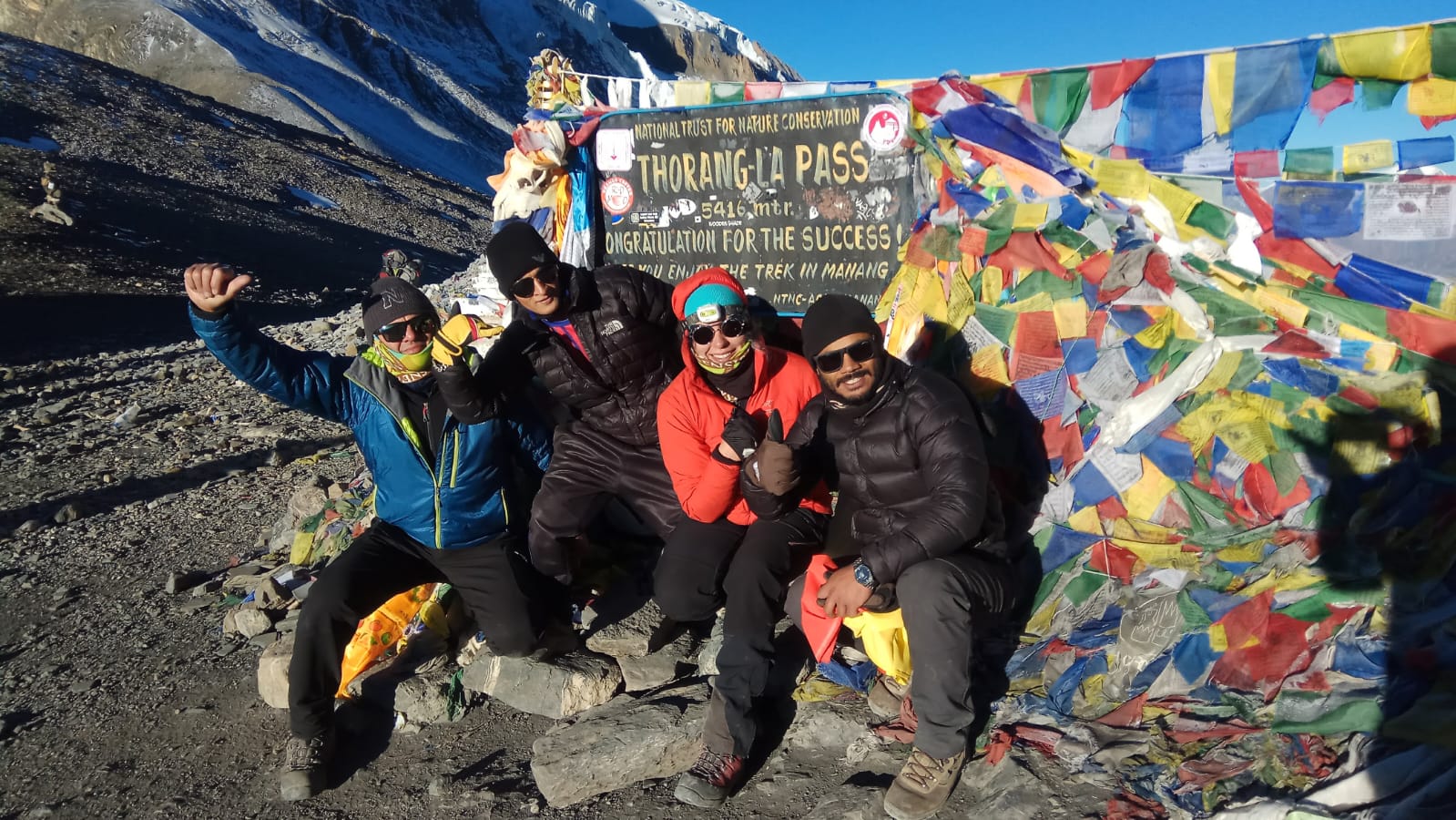
Standing at the realm of Thorong La Pass (5416 m), it is the unforgettable moment for every trekker. Moreover, it is more than crossing the highest Pass of the world but is the reward of determination, pre-trek preparation and endurance.
If you are an intermediate trekker who is willing to conquer this trekking pass, this is the journey that will test your:
- Mental and physical endurance
- Body’s fitness and stamina
- Determination
- Preparation
This trekking guide includes information of everything you must know to conquer the highest point of the Annapurna Region successfully.
Overview of Thorong La Pass
Nestled in the heart of Annapurna Region, Thorong La Pass is a high-altitude trekking pass in the world which does not require mountaineering skill. It acts as a bridge to connect two culturally and geographical separate valleys: Manang and Mustang respectively. Annapurna Circuit Trek is incomplete without crossing Thorong La. Conquering it not only give sense of physical achievement but a remarkable life experience which mark as real Himalayan trekker.
As you complete this physically demanding mountain pass, marks the shift from lush alpine valley to arid landscapes of Mustang.
Essential facts about Thorong La
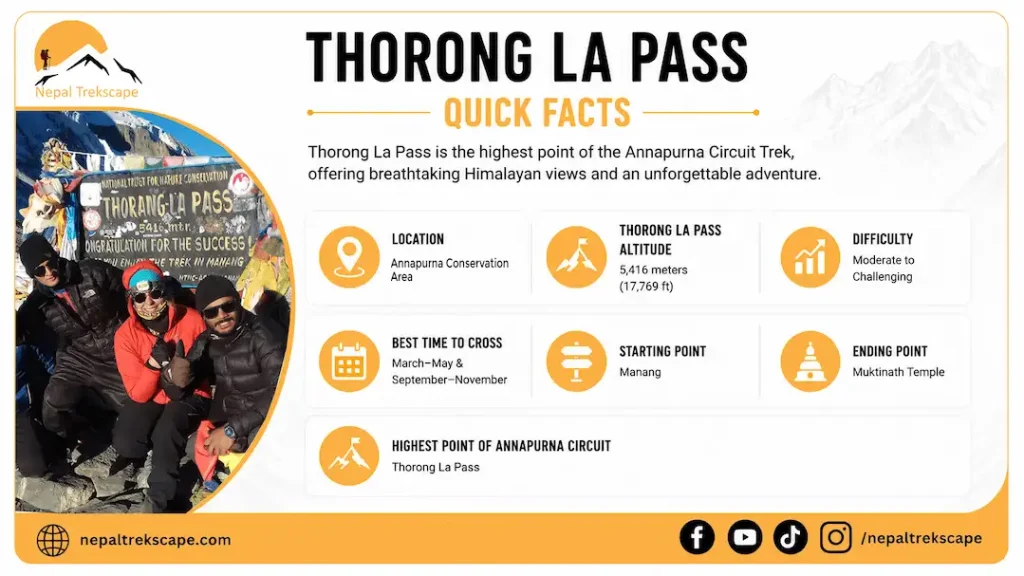
Situated in the Annapurna Conservation Area of Nepal, Thorong La lies at an elevation of approximately 5416 meters. Its route ascends from Manang Valley passing through Yak Kharka, Ledar, Thorong Phedi and High Camp before crossing it. Similarly, after crossing it, route descends to sacred pilgrimage of Mustang popularly known as Muktinath. Its difficulty level to trek is rated as moderate to challenging. Spring and Autumn season is regarded as the ideal time to conquer this mountain pass of Annapurna Circuit Trek.
Geography and Landscape
Located in the northern section of the Annapurna massif, landscape of Thorong La transition from alpine to rocky terrain. At the pass, high altitude and very cold temperature supports only sparse alpine plants. It is surrounded by Dhaulagiri massif to the west. Similarly, it is dominated by towering peak of Annapurna Massif including Annapurna II, Annapurna III and Annapurna IV to the south and southwest. Likewise, to the north and northwest, trekkers can enjoy the expansive view of Mustang region’s arid trans-Himalayan terrain.
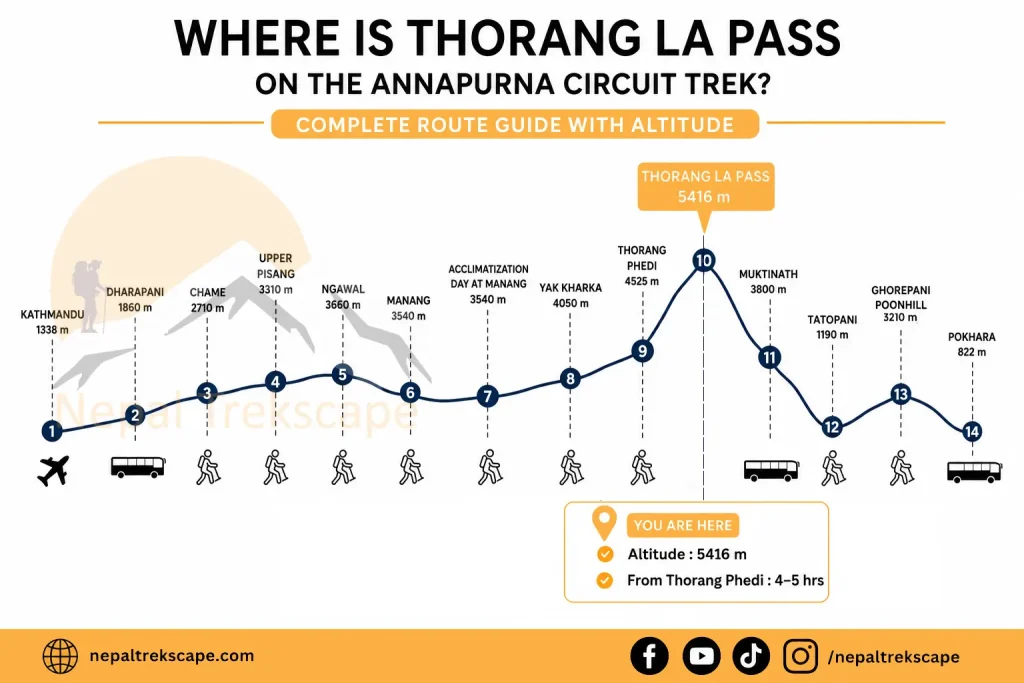
Why Thorong La Pass is popular in the Annapurna Region?
Being the highest trekking passes in the world, Thorong la is generally conquered by the non-mountaineers. Intermediate trekkers can cross it successfully if they have good physical fitness. Moreover, it is not just popular for offering the panoramic view of towering peak around its landscape but for:
Giving opportunity to experience Remote Himalayan Wilderness
Testing the determination and stamina of trekkers to conquer the highest point of the Annapurna Circuit
Why journey to cross the Thorong La is challenging for the trekkers?
Located at an altitude of 5416 meters, Thorong La has thin-air and lower oxygen level making journey to cross it challenging. Even fit trekkers feel exhausted and pace to trek is slow down than at lower-altitude. Even engaging in the simple activities causes shortness of breath. Many trekkers suffer from irregular breathing pattern while staying overnight at high-altitude causing disrupted sleep. Moreover, trekkers also suffer from frequent urination to adjust their body to altitude by discarding excess fluid.
Beside these, many trekkers are also diagnosed with Acute Mountain Sickness (AMS). Every enthusiastic trekker who are willing to cross the Thorong La must know its symptoms:
- Loss of appetite
- Vomiting
- Experiencing extremely tiredness
- Headache and dizziness
- Disrupted sleep
Likewise, trekkers often suffered from the following symptoms of High Altitude Cerebral Edeme (HACE):
- Loss of coordination causing inability to walk straight
- Extreme headache even not cured by medicines
- Suffer from hallucinations
Similarly, following are the common symptoms of High Altitude Pulmonary Edeme (HAPE):
- Rate of heartbeat becomes fast
- Nails and fingernail became blue due to reduced oxygen level
- Chest congestion
- Extreme shortness of breath while resting
- Chronic dry cough with pink frothy sputum
If the trekkers are diagnosed with above symptoms of HACE and HAPE, they must descend to lower altitude immediately. Likewise, if the condition of health gets worse and cannot descend by walking then helicopter evacuation is required.
Essential Trekking Tips to cross the Thorong La Pass
To cross the Thorong La, trekkers must follow the important trekking ettiqutte to make their unforgettable and successful such as:
- You must complete pre-trek preparation guided by your lead guide
- Never skip acclimatization day at Manang Valley
- Never skip acclimatization hike to Gangapurna as it follows the principle of “Climb High, Sleep Low”
- Always drink plenty of water while climbing uphill trail to avoid dehydration
- Always use trekking poles while climbing uphill trail to overcome stress on knee, ankle and joints
- Keep monitoring the weather forecasts
- On the day to cross the Thorong La, start your trek early in the morning to arrive the summit before afternoon wind.
Frequently Asked Questions:
What is the altitude of Thorong La Pass above sea level?
The altitude of Thorong La Pass is 5416 meters above the sea level, making it highest point on the Annapurna Circuit.
Which Himalayas are visible from the top of Thorong La Pass?
On the clear day, Himalayas visible from the top of Thorong La Pass are:
- Annapurna Range
- Dhaulagiri Range
- Gangapurna
- Tilicho Peak
Why Spring and Autumn are regarded as favourable season to cross the Thorong La?
Spring and Autumn are regarded as favourable season to cross the Thorong La because:
- Weather is stable
- Condition of trail is good
- There is no problem of haze
- Clear skies offer the stunning views of snowcapped peaks
What are the essential permits required for Thorong La Pass Trek?
The essential permit required for Thorong La Pass Trek is Annapurna Conservation Area Permit (ACAP).
Do I need to hire guide and porter for Thorong La Pass Trek?
Absolutely, if you are an international trekker then you must hire a certified trekking guide for Thorang La Pass Trek. You are not permitted to trek independently according to the law formulated by government.
In case of porter, it is not compulsory to hire as it completely depends on your requirement. If you have light bag pack and can carry throughout your trek by yourself then it is not necessary to hire porter. We recommend you to hire porter for comfortable walk when you have heavy bag pack with essential trekking gears.
Are you currently planning for Thorong La Pass Trek? We suggest you to hire government licensed guide and porter through registered trekking agency like Nepal Trekscape to operate your trek.
How difficult is cross the Thorong La?
Thorong La Pass difficulty to cross is categorized as moderate to challenging because of:
- Reduced oxygen level and thin air due to high altitude
- 8 to 10 hours of continuous walk is demanded on the pass day
- Extremely cold temperature
- Risk of High Altitude Sickness
- Demading steep uphill and downhill walk
What should I pack for Thorong La Pass Trek?
You must pack the following packing items for Thorong La Pass Trek:
- Down jackets and warm layered clothing
- Warm gloves
- Trekking poles
- Headlamps
- First aid kit with important medicines such as Diamox
- Raincoat
- Water Bottle
- Quick-drying towels
- Waterproof trekking boots
- Sleeping bags rated for negative 10 degree Celsius to 15 degrees Celsius
- 20-30L Daypack
- 90-100L Duffle Bag (It is provided by the trekking agency who is organizing your trek)
- Neck Gaiter
- High SPF sunscreen and lip balm
- Chemical free soap and toothpaste
- Biodegradable Toothbrush made up of bamboo is recommended